Human + Machine: Claim the Phantom Zone, or Be Replaced by It
Hi everyone!
I just finished reading Human + Machine: Reimagining Work in the Age of AI by Paul R. Daugherty and H. James Wilson, and I want to talk about the one idea from it that’s been rattling around in my head for weeks.
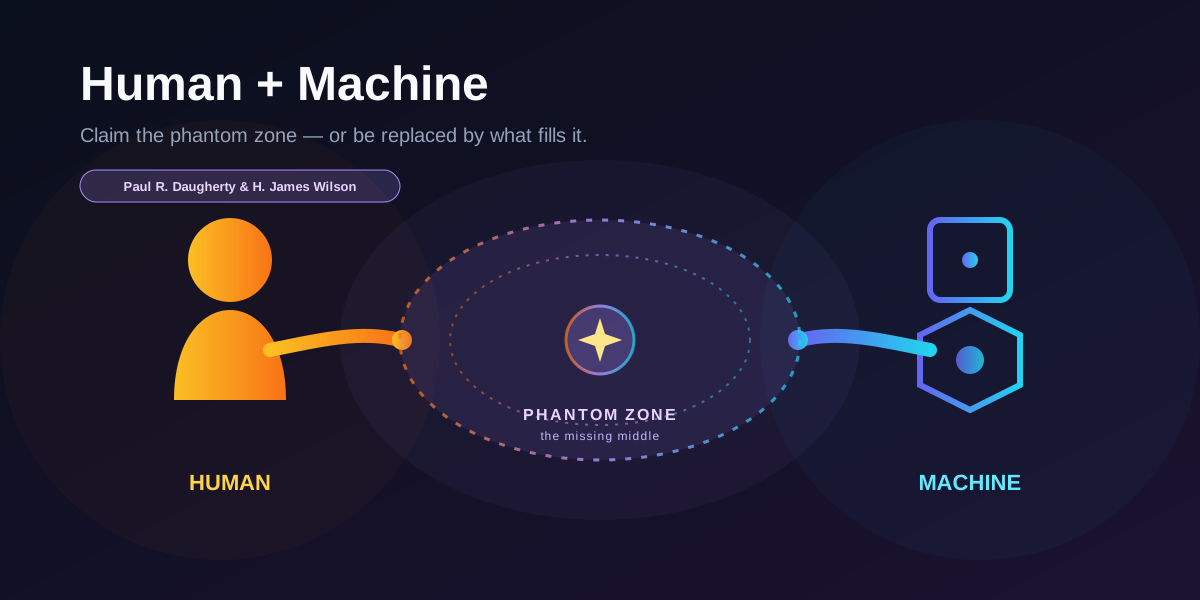
The book’s central claim is simple and uncomfortable: the future of work isn’t humans vs. machines, and it isn’t machines replacing humans either. It’s a third space — a collaborative zone where humans and AI together do things neither could do alone. The authors call it the “missing middle.” I’ve started thinking of it as the phantom zone: invisible to anyone still framing the debate as “us or them,” but very real for the people standing in it.
The trap of the binary debate
Most AI conversations get stuck in two camps:
- “AI will replace us.” Anxious, fatalistic, paralyzing.
- “AI is just a tool, nothing changes.” Comforting, complacent, wrong.
Both miss the point. Daugherty and Wilson’s argument — backed by their work at Accenture studying companies actually deploying AI at scale — is that the largest gains, by far, come from companies that redesign work around human-machine collaboration instead of using AI to do the same old jobs faster.
The pure-automation play (replace people with bots) gives modest gains. The pure-status-quo play (ignore AI) is slow suicide. The companies winning are the ones treating AI as a new kind of teammate and rebuilding roles around what humans and machines each do best.
That’s the phantom zone. And the book’s quiet warning is: if you don’t stand in it on purpose, something else will fill it without you.
What lives in the phantom zone
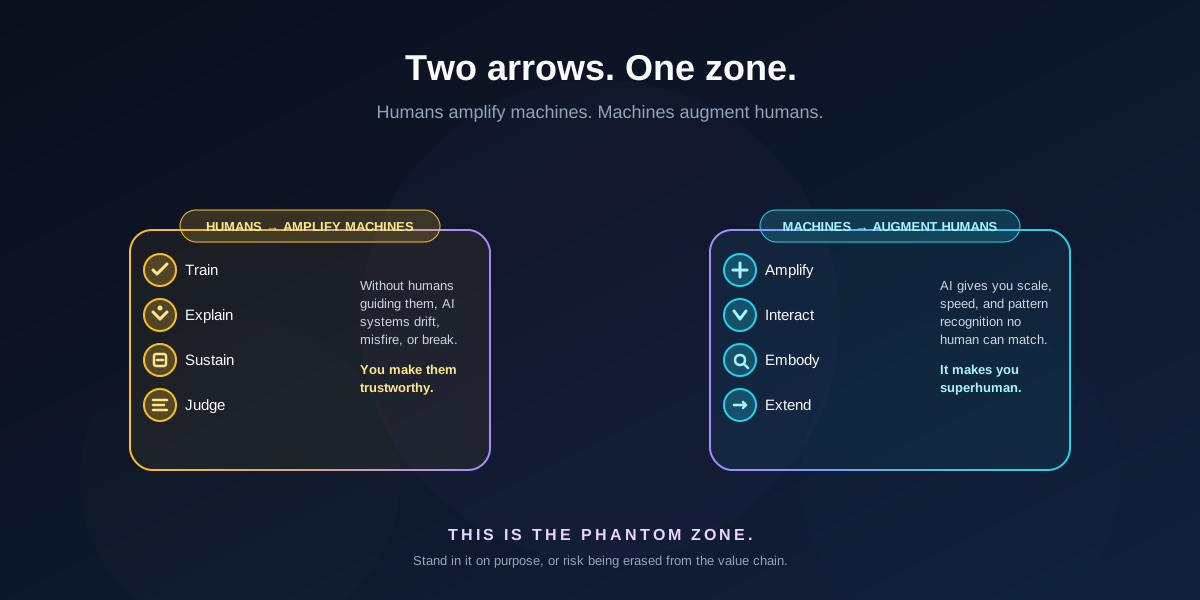
The authors break the collaborative space into two arrows running in opposite directions:
Humans → amplify machines
Things only humans should do (for now, anyway):
- Train — feed AI systems the right data, the right examples, the right edge cases.
- Explain — translate what a model did into something humans can understand, defend, and act on.
- Sustain — monitor for drift, fairness issues, hallucinations, and the ten thousand ways a system can quietly degrade.
- Judge — make the calls that involve ethics, context, accountability, or anything where being wrong has consequences.
If you remove humans from this loop, AI systems don’t become more autonomous — they become more dangerous.
Machines → augment humans
Things AI does that make humans superhuman:
- Amplify our cognitive reach: scan more, remember more, correlate more.
- Interact at scale: handle the routine so humans handle the meaningful.
- Embody new capabilities: vision, prediction, real-time pattern recognition.
- Extend us into places we can’t go physically or temporally — labs, supply chains, simulations.
Done right, this isn’t humans being made obsolete. It’s humans being made leveraged.
Why “succumbing” is the real failure mode
Here’s what I keep coming back to. The risk most people fear is AI taking their job. The risk that’s actually larger, and quieter, is abdicating the phantom zone — outsourcing not just the work but the thinking, the judgment, the responsibility to a model and then standing around as a passive intermediary.
That role gets erased. Not by a robot. By the next person, or the next company, that figures out how to stand in the phantom zone on purpose — with skill, with intent, with discipline.
Succumbing doesn’t look like a robot at your desk. It looks like:
- Pasting prompts in and shipping output you don’t fully understand.
- Letting the model decide what’s true because checking is hard.
- Removing yourself from the parts of the work that require taste, judgment, or context — the parts that AI is worst at — because they’re slower than just “asking the AI.”
You can keep your job for years doing that. But you’ve already left the phantom zone, and the value has left with you.
How to actually stand in it
The book is full of case studies, but if I had to compress the practical advice into something that fits on a sticky note:
- Keep your hands on the wheel of judgment. Use AI to widen what you consider, never to decide what matters.
- Be the explainer in the room. If you can translate between what a model does and what a human stakeholder needs, you’re irreplaceable.
- Get fluent with at least one AI tool you actually depend on. Fluency means knowing where it fails as deeply as where it shines.
- Treat “AI did it” as never being a complete answer. Sign your name to the work or don’t ship it.
- Redesign your own work, before someone else does. Ask: which 30% of my week could AI carry, and what higher-leverage thing should I do with the time it frees up?
That last one is the kicker. Daugherty and Wilson’s whole thesis is that the value isn’t in using AI — it’s in redesigning what humans do around the fact that AI exists. Most people stop one level short of that.
Why I’d recommend the book
A few caveats: Human + Machine came out before the generative AI explosion, so the examples skew toward predictive ML, computer vision, and process automation rather than LLM agents. Some of the technology framing reads as dated.
The framework, though, holds up better than almost anything written since. The “missing middle” concept, the human-amplifying-machine vs. machine-amplifying-human split, and the warning about companies that automate without rethinking — these are more relevant now, not less. If you swap “machine learning model” for “agent” in your head as you read, the book practically reads like it was written for the 2026 generative-AI moment.
It’s also short, well-structured, and full of practical playbook material. Read it in a weekend. Use it for years.
Closing thoughts
The phantom zone is real. It’s where the leverage is, where the meaning is, and where the careers worth having over the next decade will be built.
The question the book leaves you with — and the question I’m asking myself almost daily now — is simple:
Am I standing in it, or am I letting it stand empty?
See you next time!
📚 Human + Machine: Reimagining Work in the Age of AI — Paul R. Daugherty & H. James Wilson — Amazon