Antifragile: Why Good People and Good Organizations Gain from Disorder
Hi everyone!
There’s a word I keep coming back to whenever I think about careers, companies, relationships, or my own habits: antifragile.
I borrowed it — like everyone else — from Nassim Nicholas Taleb’s book Antifragile: Things That Gain from Disorder. It’s a dense, opinionated, occasionally infuriating book. It’s also one of the few I’ve read that genuinely changed how I make decisions.
This post is my journal-style attempt to explain the idea simply, and to argue that both people and organizations need to be designed for it on purpose — because the alternative isn’t safety. The alternative is slow, invisible breakage.
The triad
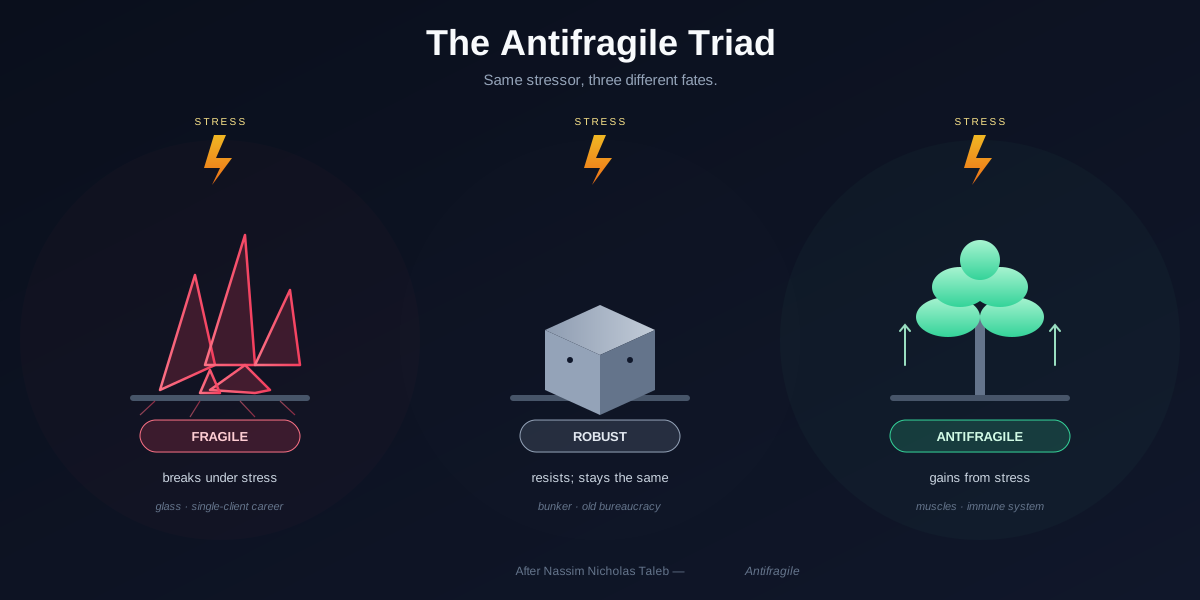
Taleb’s core move is splitting the world into three categories, not two.
- Fragile — things that break under stress, volatility, randomness. A wine glass. A career built on one client. An identity built on one job title. A supply chain with a single vendor.
- Robust — things that resist stress and stay the same. A rock. A bunker. A bureaucracy. Solid, but it never grows from what it survives.
- Antifragile — things that gain from stress. Muscles get stronger from load. The immune system learns from exposure. Ecosystems regenerate after fires. Good startups get sharper from a near-death experience. Skilled humans get better from criticism that would crush a fragile ego.
The trick most people pull is conflating “robust” with “good enough.” It isn’t. Robust is just delayed fragility — it holds until the day it doesn’t, and then there’s nothing to show for the years of holding.
Antifragile systems aren’t lucky. They’re designed to feed on the randomness they encounter. That’s a different posture toward the world.
What this looks like for a person
Personal antifragility isn’t a vibe. It shows up in concrete patterns:
- You have skills that compound from exposure. Writing, public speaking, coding, sales — the more reps under pressure, the better you get. You volunteer for them.
- You have multiple, small, uncorrelated income or learning streams instead of one big bet. If any one collapses, the others still pull.
- You expose yourself to small doses of stress on purpose — hard workouts, fasting, cold, public criticism, public commitments. Hormesis: a little poison is a vaccine.
- You treat mistakes as fuel, not shame. A fragile ego treats every error as an attack on identity. An antifragile mind treats it as data and a free upgrade.
- You keep your downside floored. Don’t go bankrupt. Don’t blow up your reputation. Don’t compromise health. Antifragility requires surviving long enough for the upside to arrive.
People who look “lucky” over decades are almost always running this playbook quietly.
What this looks like for an organization
Most organizations are accidentally fragile and proud of it. The patterns:
- One huge client = one huge cliff.
- Single points of failure in tech, leadership, knowledge.
- A culture that punishes small failures ensures the only failures left are the ones too big to hide.
- Forecasts treated as facts. Plans optimized for a precise future that won’t happen.
- No slack. No redundancy. Every system running at 100%. Looks efficient. Detonates on the first real shock.
Antifragile organizations look different:
- Many small bets, most of which fail cheaply, a few of which pay enormously.
- Decentralized authority — small mistakes locally, no catastrophic mistakes globally.
- Optionality everywhere — the ability to pivot is built into contracts, products, hiring.
- Slack on purpose. Time, money, and people who aren’t fully booked. Slack is the system’s ability to absorb a shock and learn from it.
- Skin in the game at every level — the people making decisions feel the downside if they’re wrong.
The 2020s have been a sustained stress test for organizations. The ones still standing — and stronger — are not the ones that planned best. They’re the ones that were designed to be surprised.
The barbell and the convex payoff
Two of Taleb’s most actionable ideas:
The barbell
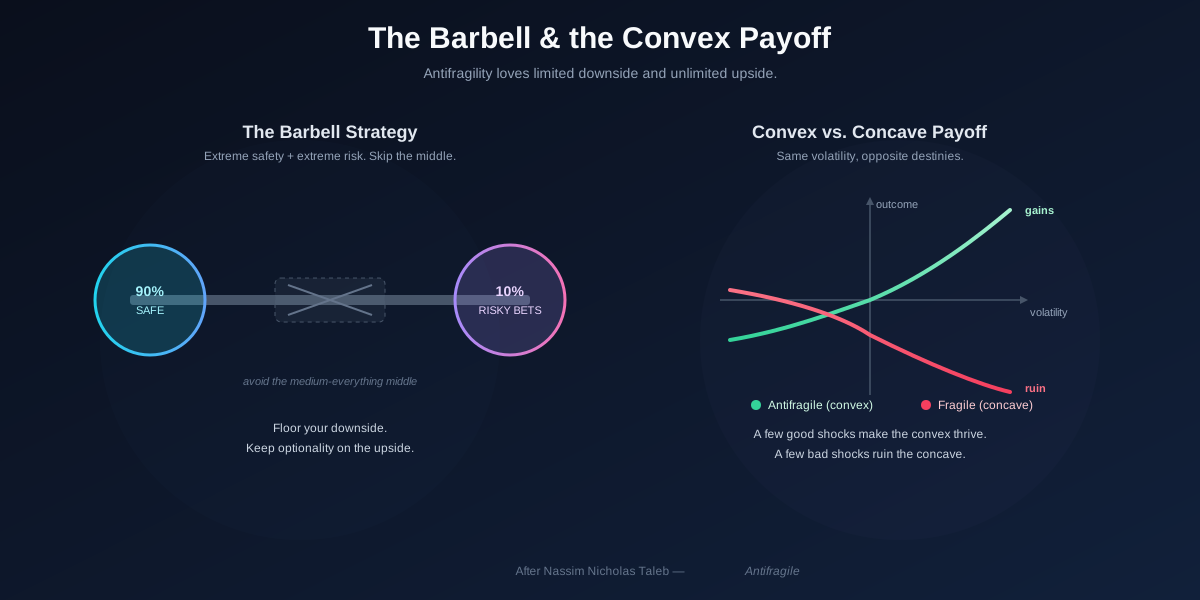
Don’t spread yourself evenly across the risk spectrum. Be extremely conservative on one end and extremely aggressive on the other, with nothing in the middle.
- Personally: most of your income in stable, low-stress work; a small part in wild, high-upside experiments (a side project, a niche bet, a book, a startup).
- Financially: most of your money in genuinely safe assets; a small slice in things with explosive upside.
- Career: a stable backbone of skills people will always pay for; deliberate experiments at the frontier.
The middle — “moderate risk, moderate reward, medium-everything” — is where most people live and where fragility hides. It feels balanced. It’s actually exposure without the upside.
Convex vs. concave payoffs
When volatility hits, your shape matters more than your average:
- A concave (fragile) payoff curves down. A few bad shocks ruin you. Many small wins can’t compensate.
- A convex (antifragile) payoff curves up. A few good shocks make you rich, famous, or transformed. Many small losses don’t matter because the downside is capped.
Antifragility, in one line: shape your life and your work so that surprises tend to help you more than hurt you.
Via negativa: remove fragility before you add anything
The book’s quiet superpower is via negativa — the idea that you build antifragility mainly by subtracting fragility, not adding strength.
- Drop the toxic relationship before you read another self-help book.
- Cancel the contract with the customer who pays you well and stresses you to ruin.
- Quit the side bet you can’t survive losing.
- Stop the habit that’s slowly eating you, even before you start the new “great” one.
You can’t grow on rotten ground. Antifragility starts with removing what would break you first.
A few honest caveats
A few things worth saying out loud:
- Taleb writes like he wants to fight you. The tone can be a lot. The framework is worth the irritation.
- “Antifragile” gets misused as a buzzword by people who really mean “tough.” It isn’t the same — toughness is robust. Antifragile is something else.
- Some domains genuinely should be fragile-averse, full stop. You don’t want an antifragile airline that “learns” from crashes. The framework is most useful where small failures are survivable and large upside exists.
But for almost everything in a personal life and a small-to-medium organization, the lens works. Once you see it, you can’t unsee it.
Closing thoughts
The world isn’t getting calmer. It’s getting more volatile, more networked, more shock-prone. The instinct of most people, and most companies, is to respond by adding more rigidity, more plans, more control. That’s the fragile move. It feels safer and quietly raises the stakes.
The harder, better path is to design yourself, your work, and your organization so that disorder makes you better, not weaker. Small bets. Floored downside. Optionality. Skin in the game. Subtract fragility first.
The book’s title is the whole thesis: antifragile. Read it once. Then live the next decade trying to deserve the word.
See you next time!
📚 Antifragile: Things That Gain from Disorder — Nassim Nicholas Taleb — Amazon